
Authentic Embroidered Dirndl Dresses
Embroidery is what turns a good dirndl into one people stop to admire. A few lines of stitching on the bodice, a pattern climbing the apron, a leaf motif along the hem: these small details carry much of the character of traditional Bavarian clothing.
They also make the dress harder to shop for. Two dirndls can look similar in a photo and feel very different in person. One has crisp, dense stitching on a well-built bodice. The other has thin, loose thread on a flimsy base.
This guide covers what authentic embroidered dirndl dresses are, how to judge the stitching and fabric, how to get the fit right, and how to wear and care for one. It is useful whether you are buying your first dirndl or adding a more detailed piece to your collection.
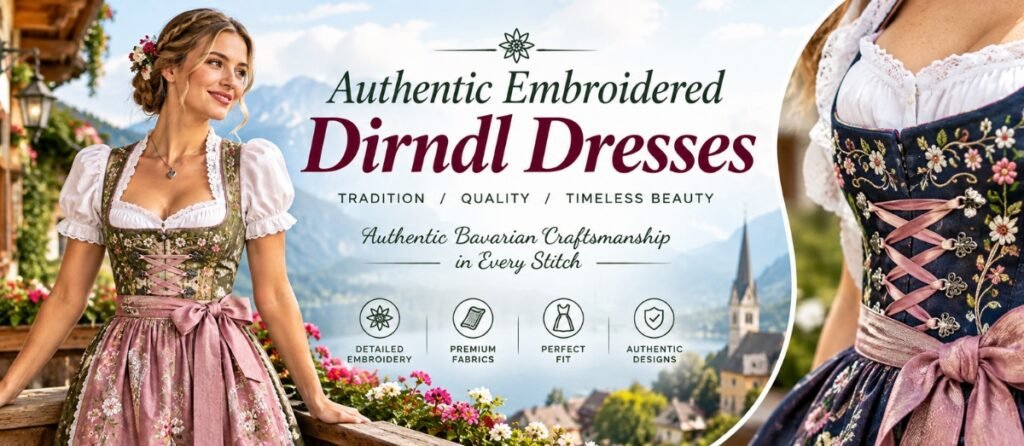
What Makes Authentic Embroidered Dirndl Dresses Different?
Let’s be upfront about one thing: “authentic” has no official certificate attached. There is no single stamp that proves a dirndl is the real thing. What you can do is look at how the dress is built and whether it follows the traditional pattern.
A traditional dirndl has four parts that work together:
- The bodice is the fitted top, usually closed with lacing, hooks or buttons.
- The blouse sits underneath and frames the neckline and shoulders.
- The skirt is full, gathered or pleated, and gives the dress its movement.
- The apron ties at the waist and often carries the most decoration.
In an embroidered dirndl, the stitching usually appears on the bodice, the apron, or both. Some dresses also add a border at the hem or trim along the neckline. Authentic styling follows the structure of the dress. The embroidery supports the shape and doesn’t fight it.
Common Embroidery Motifs and What They Mean
Traditional Bavarian and Alpine embroidery draws on nature and local life. You will often see:
- Edelweiss: The best-known Alpine flower, a popular symbol of the mountains.
- Gentian and other wildflowers: Small blossoms in blue, purple or yellow.
- Roses and vines: Softer, more romantic designs, common on aprons.
- Oak leaves and acorns: A classic Bavarian motif.
- Geometric borders: Repeating patterns along hems, cuffs and edges.
You don’t need to know the story behind every pattern to enjoy it. But if you pick a motif you like, you will probably enjoy wearing the dress more.
Placement matters
Where the embroidery sits changes the look:
- On the bodice: It draws the eye to the upper body and frames the neckline.
- On the apron: It creates a focal point at the waist, and it is easy to swap the apron if you want a different look.
- On the hem: A border near the hem adds weight to the skirt and works well on longer dresses.
If you prefer a quieter look, choose a dress with embroidery in one area only. If you love detail, choose one with decoration on both bodice and apron.
Hand Embroidery vs Machine Embroidery
Both can be well made. The difference lies in the finish and the price.
Hand embroidery is slower to produce. The stitches can show slight variations, and the work often feels more dimensional. Machine embroidery is more consistent and lets makers produce intricate patterns at a lower cost. A good machine-embroidered dress still looks neat and holds up well.
Rather than judge by label alone, look at the details:
- Stitch density: Dense, even stitching usually holds up better than thin, sparse thread.
- Edges: Clean outlines suggest careful work.
- Back of the fabric: Neat backing and no loose threads are a good sign.
- Thread quality: It should have a soft sheen and not look fuzzy.
- Consistency: Motifs on the left and right sides should match.
If a seller says the embroidery is hand-done, check that the product description gives some detail. If it doesn’t, ask.
Fabrics That Work Well With Embroidery
Embroidery needs a base that can support it. These are the fabrics you will meet most often:
- Cotton: Breathable, easy to wear and good for warm tents and long days.
- Cotton blends: Often more wrinkle-resistant than pure cotton.
- Velvet: Rich and dramatic. Embroidery on velvet looks lavish, but it feels warm indoors.
- Linen and linen blends: Cool, with a natural texture.
- Wool and heavier fabrics: Good for cooler weather and autumn events.
- Brocade and jacquard: Patterned fabrics that add texture on their own, so heavy embroidery on top may feel busy.
For a first embroidered dirndl, cotton or a cotton blend is a sensible choice. It is comfortable and forgiving, and it works for most events. Velvet is lovely for an autumn wedding or a cooler festival, but may be too warm for a crowded summer event.
Choosing Colors and Thread Colors
Think about two colors: the dress and the embroidery.
- Dark dress, light thread: Black, navy or dark green with cream, gold or white embroidery gives a classic, high-contrast look.
- Light dress, tonal thread: Cream or pastel dresses with matching thread look soft and subtle.
- Bold dress, simple thread: If the fabric is a strong color like red or royal blue, keep the embroidery restrained.
Traditional combinations are easy to wear: green with cream, blue with white, burgundy with gold. If you plan to wear the dress more than once, a classic palette gives you more ways to restyle it with different aprons and blouses.
Getting the Fit Right
Embroidery can make a bodice slightly stiffer, so fit matters more than usual. A heavily embroidered bodice is harder to alter, because the stitching restricts how much a tailor can adjust it.
Start with accurate measurements:
- Bust: Measure around the fullest part, keeping the tape level.
- Waist: Measure at your natural waist.
- Hips: Measure around the fullest part of your hips.
- Height: This helps you judge where the hem will fall.
Compare these numbers with the product’s own size chart, not with the chart of another shop. Dirndl sizing doesn’t follow everyday sizing, and every maker sizes a little differently. For a deeper look, read our dirndl sizing guide.
A well-fitting bodice feels supportive but not squeezing. You should be able to breathe, sit and lift your arms. If you have a fuller figure, our page on a plus size dirndl dress has more on sizing and comfort.
Blouse Choices for an Embroidered Dirndl
Let the dress carry the detail. A plain white or cream cotton blouse usually works best under an embroidered bodice. It lets the stitching stand out.
- Puff sleeves: The classic choice, and a lovely match for a decorated bodice.
- Short or elbow-length sleeves: More practical for warm weather.
- Lace trim: A small amount looks pretty. Too much competes with the embroidery.
If both the blouse and the bodice are heavily patterned, the outfit can feel crowded. When in doubt, keep one of them simple.
How to Style Authentic Embroidered Dirndl Dresses
The embroidery is already the star, so keep the styling calm:
- Jewelry: A simple necklace or small earrings. A traditional charm necklace is a nice touch, but avoid stacking several statement pieces.
- Apron: If the dress has embroidery, a plain or lightly patterned apron balances it. If the apron is the embroidered piece, choose a simpler bodice.
- Shoes: Comfortable flats, low block heels or traditional shoes. You may be standing for hours.
- Hair: Braids, pinned-up styles or a half-up look keep the neckline visible.
- Bag: A small crossbody leaves your hands free.
- Layers: A cardigan or shawl helps in cooler weather and doesn’t hide the embroidery.
One traditional detail is worth knowing. The position of the apron bow has a meaning: left usually means single, right means taken. Tie it the way you want to be read.
Where to Wear an Embroidered Dirndl
Embroidered dirndls are not only for Oktoberfest. They suit:
- Oktoberfest and other beer festivals
- Bavarian and German cultural events
- Folk festivals and parades
- Weddings and formal celebrations
- Theme parties
- Christmas markets and autumn gatherings
The more detailed the dress, the more it suits an occasion where people will see it up close. A richly embroidered dress feels at home at a wedding or a cultural celebration. For a crowded, lively tent, a simpler cotton style may be more practical.
Embroidered Dirndl for Oktoberfest
If you are choosing a dirndl for Oktoberfest, plan the whole day around comfort. The 191st Oktoberfest takes place at Munich’s Theresienwiese from September 19 to October 4, 2026. That means this year’s festival is almost over, so a new dress is probably better aimed at 2027, which is listed for Saturday 18 September to Sunday 3 October, or at another autumn event. For background on the festival, see the Wikipedia page on Oktoberfest. MunichMunich Oktoberfest
For a long day at a festival, consider:
- Comfort: You will sit on benches, walk a lot and possibly dance.
- Fabric: Cotton or a cotton blend is easier in a warm tent than velvet.
- Embroidery: Stitching that lies flat is more comfortable than raised decoration.
- Length: Midi is the most practical for crowds.
- Layers: Evenings can be cool.
You can browse a Oktoberfest embroidered dirndl dress or a green velvet embroidered dirndl to see how embroidery and fabric work together.
How to Buy Authentic Embroidered Dirndl Dresses Online
You can shop for these dresses online with confidence if you check the right details:
- Zoom in on the photos. Look closely at stitching, edges and bodice shape.
- Read the fabric description. It should tell you what the dress and the embroidery are made from.
- Check the size chart. Use your own measurements, not just S, M, L.
- Check what’s included. Some listings include a blouse and apron, and some don’t.
- Look at shipping and returns. Read the terms before you pay.
- Read the full description. Details about length, closure and lining matter.
On Dirndlsonline.com, each product page carries its own size information, so compare your numbers with the chart for the exact dress you want. You can also browse our embroidered dirndl dresses page and read our tips on buying perfect fit dirndl dresses online.
Caring for Embroidery
Embroidery needs a little gentle handling.
- Read the care label first. Some dirndls are dry-clean only, and others tolerate a gentle wash.
- Spot clean small marks. It is often kinder than a full wash.
- Avoid bleach. It can fade thread and fabric.
- Dry flat or hang. Don’t wring or twist the embroidered areas.
- Store on a padded hanger. Keep it out of direct sunlight.
Velvet needs extra care. Brush it gently and avoid pressing the pile.
Common Mistakes When Buying an Embroidered Dirndl
- Choosing by looks alone. A pretty photo doesn’t tell you how it fits.
- Ignoring the size chart. Each maker differs.
- Overlooking the fabric. Heavy velvet in a hot tent is uncomfortable.
- Too much pattern. A busy dress with a busy blouse and apron competes with itself.
- Forgetting to check what’s included. You may need a separate blouse or apron.
- Ignoring skirt length. Check the hem against your height.
- Skipping the care label. It affects how long the dress lasts.
- Ordering at the last minute. Allow time to try it on and sort out any size issues.
Frequently Asked Questions
What are authentic embroidered dirndl dresses?
They are traditional dirndls that follow the classic structure of bodice, blouse, skirt and apron, with embroidery as part of the design. The embroidery may appear on the bodice, the apron, or both.
How can I tell if the embroidery is good quality?
Look for dense, even stitching, clean edges and matching motifs on both sides. Check the back of the fabric if there is a photo of it. Loose threads and uneven patterns suggest weaker work.
Is hand embroidery better than machine embroidery?
Not always. Hand embroidery has a distinctive look, but good machine embroidery can be neat and durable. Judge the finish, not just the method.
What fabric is best for an embroidered dirndl?
Cotton and cotton blends are the most practical for most events. Velvet suits cooler weather and formal occasions.
Can I wear an embroidered dirndl to Oktoberfest?
Yes. Embroidered dirndls are a common sight at festivals. Choose a comfortable fabric and a bodice that lets you sit and move.
Should I buy a larger size to allow for the embroidery?
Not automatically. Compare your measurements with the size chart, and if you are between sizes, ask the seller. Embroidered bodices can be harder to alter later.
Are authentic embroidered dirndl dresses suitable for weddings?
Yes. A richly embroidered dress in a cream, green or burgundy tone suits a Bavarian-themed or traditional wedding. Avoid white if you are a guest.
Conclusion
Authentic embroidered dirndl dresses reward a little care at the buying stage. Look at the stitching, check the fabric, measure yourself accurately and choose a style that suits the event and your comfort. Keep the styling simple so the embroidery can stand out, and look after the dress properly afterward.
If you are ready to look, Dirndlsonline.com has a range of embroidered styles, with size information on each product page.